> ## Documentation Index
> Fetch the complete documentation index at: https://chatcli.edilsonfreitas.com/llms.txt
> Use this file to discover all available pages before exploring further.
# Task Graph
> Execute an approved multi-task plan as a verified DAG: parallel squad workers per task, validation gates the engine runs itself, and an independent reviewer verdict before anything counts as done — with a live browser dashboard.
The **Task Graph** turns an approved plan into a persisted DAG executed by parallel [squad workers](/agents/agent-squad) — with one non-negotiable rule: **done is never the executor's self-report**.
```text theme={"system"}
plan → task graph → parallel execution → engine-run gate → independent review → done | retry
```
With several agents working in parallel, a task wrongly self-declared as complete unblocks its dependents on a false premise. The task graph makes verification structural instead of narrative: the orchestrator is deterministic Go code (not an LLM), the validation commands are executed by the engine itself, and the verdict comes from a **fresh reviewer worker** that never shares context with the executor.
***
## When to use it
| Situation | Right tool |
| - | - |
| 1–4 tasks, or strictly serial work | Direct `agent_call` workers or the [squad playbook](/agents/agent-squad) |
| **5+ tasks with real independence**, an approved plan, a verifiable deliverable | **`@taskgraph`** — the parallelism pays for the orchestration overhead |
The embedded `task-graph` [skill](/tools/builtin-skills) teaches the model this ruler, the plan schema and the discipline ("you never declare done").
You don't have to ask for it by name. A substantial task (complexity ≥ 6) is **auto-routed** here by default — see [Plan-and-Solve → Routing to the task graph](/agents/harness/plan-and-solve#routing-to-the-task-graph). The routing steers, it doesn't force: genuinely serial or small work still runs directly.
***
## The plan schema
One JSON object describes the whole delivery:
```json theme={"system"}
{
"name": "feature-x",
"require_review": true,
"phases": [{"id": "F1", "title": "Server"}, {"id": "F2", "title": "Client"}],
"tasks": [
{"id": "T1", "phase": "F1", "title": "Add /foo endpoint", "agent": "coder",
"prompt": "Implement GET /foo in server/handler.go returning ...",
"validation": [{"run": "go test ./server/...", "expect": "all green, includes a /foo case"}]},
{"id": "T2", "phase": "F2", "title": "CLI client", "deps": ["T1"],
"prompt": "Add the /foo client call. Server contract: #T1",
"validation": [{"run": "go build ./...", "expect": "builds clean"}]}
]
}
```
* `deps` may only reference tasks declared **earlier** (which also rules out cycles).
* `prompt` must be self-contained — workers do not see the conversation. `#` is replaced with that dependency's output.
* `validation[].run` commands are executed by the **engine** (inheriting the [coder sandbox](/coder/coder-security) and the unsafe-command denylist) — never by the executor. `expect` is prose for the reviewer. A bare string is a prose-only contract (reviewer verifies by inspection).
* `agent` defaults to `coder` (any squad worker type works); `max_attempts` defaults to 3; `require_review` defaults to **true**, per graph or per task.
* `tools` optionally grants the task's **executor** worker session plugins — `"tools": ["@browser", "@websearch"]`. The reviewer never receives them. See [Worker capabilities](#worker-capabilities) below.
***
## Execution: ready-set scheduling
Tasks fire the moment their dependencies complete — no level barriers, no wasted wall-clock. Concurrency is capped by the squad's existing `CHATCLI_AGENT_MAX_WORKERS` knob (the graph's own `max_parallel` can lower it); **no new environment variables** were added for this feature.
Each task runs through an attempt loop:
1. **Checkpoint** — a [shadow-git snapshot](/coder/coder-plugin#checkpoints) of the workspace, best-effort, before the executor starts.
2. **Executor** — a fresh worker receives the prompt (plus reviewer feedback on retries).
3. **Gate** — the engine runs every `validation[].run` command itself and records output; a non-zero exit fails the attempt without spending a reviewer.
4. **Review** — a fresh `reviewer` worker (read-only tools) receives the contract, the gate outputs and the executor's report, and must end with `VERDICT: PASS — evidence` or `VERDICT: FAIL — what is missing`.
5. **Promote or retry** — gate green + PASS promotes to `done` with the evidence recorded; FAIL retries with the feedback injected, up to `max_attempts`, then the task fails and its successors become `blocked`.
The engine **refuses**: dependency cycles, starting a task with unmet deps, promoting without gate + verdict when review is required, and reviewer = executor (each is a distinct dispatch — both run IDs are recorded on the attempt as proof).
States: `pending → running → reviewing → done | failed | blocked`.
Every attempt also carries its **real cost**: each worker LLM call is attributed to the graph node that spawned it, using the same per-call accounting as [cost tracking](/providers/cost-tracking).
***
## Surfaces
### `@taskgraph` (for the AI)
```json theme={"system"}
{"cmd":"run","args":{"file":"/tmp/plan.json"}} // run a plan from a file (RECOMMENDED)
{"cmd":"run","args":{"graph":{...}}} // plan + execute inline (small graphs only)
{"cmd":"run","args":{"id":"tg-..."}} // run/resume a persisted plan
{"cmd":"plan","args":{"file":"..."}} // validate + persist only (file or inline graph)
{"cmd":"status"} // per-task status, attempts, verdicts, cost
{"cmd":"show","args":{"task":"T3"}} // one task in full: gate outputs, evidence, run ids
{"cmd":"retry","args":{"task":"T3"}} // re-open a failed task (+1 attempt) and resume
{"cmd":"cancel"} // stop the active run
{"cmd":"list"} // persisted runs
{"cmd":"dash"} // serve the live dashboard, returns its URL
{"cmd":"prune","args":{"older_than":"7d"}} // remove old runs ("all" keeps only the active one)
```
**File first for real graphs.** Inline `graph` args beyond \~2KB get truncated by output-token limits ("unexpected end of JSON input"). The reliable form is two calls: write the plan JSON with `@coder write`, then `run` with `file` — the file may hold the bare plan, `{"graph":{...}}` or the full envelope. The embedded skill teaches the model exactly this.
`run` executes the whole graph in a single tool call, streaming events as they happen. Resume is inherent: completed tasks stay done, so re-running a failed graph continues where it stopped.
### `/taskgraph` (for humans)
```bash theme={"system"}
/taskgraph status [id] # per-task status, verdicts, cost
/taskgraph show T3 [id] # one task: attempts, gate outputs, evidence
/taskgraph list # persisted runs
/taskgraph dash [id] # open the live browser dashboard
/taskgraph prune [7d|all] # remove old runs (default 30d; the active run is never removed)
/taskgraph cancel # stop the active run
```
`/taskgraph` is allowlisted as a **mid-run side command** — type it while the graph executes to inspect progress without touching the orchestrator loop.
***
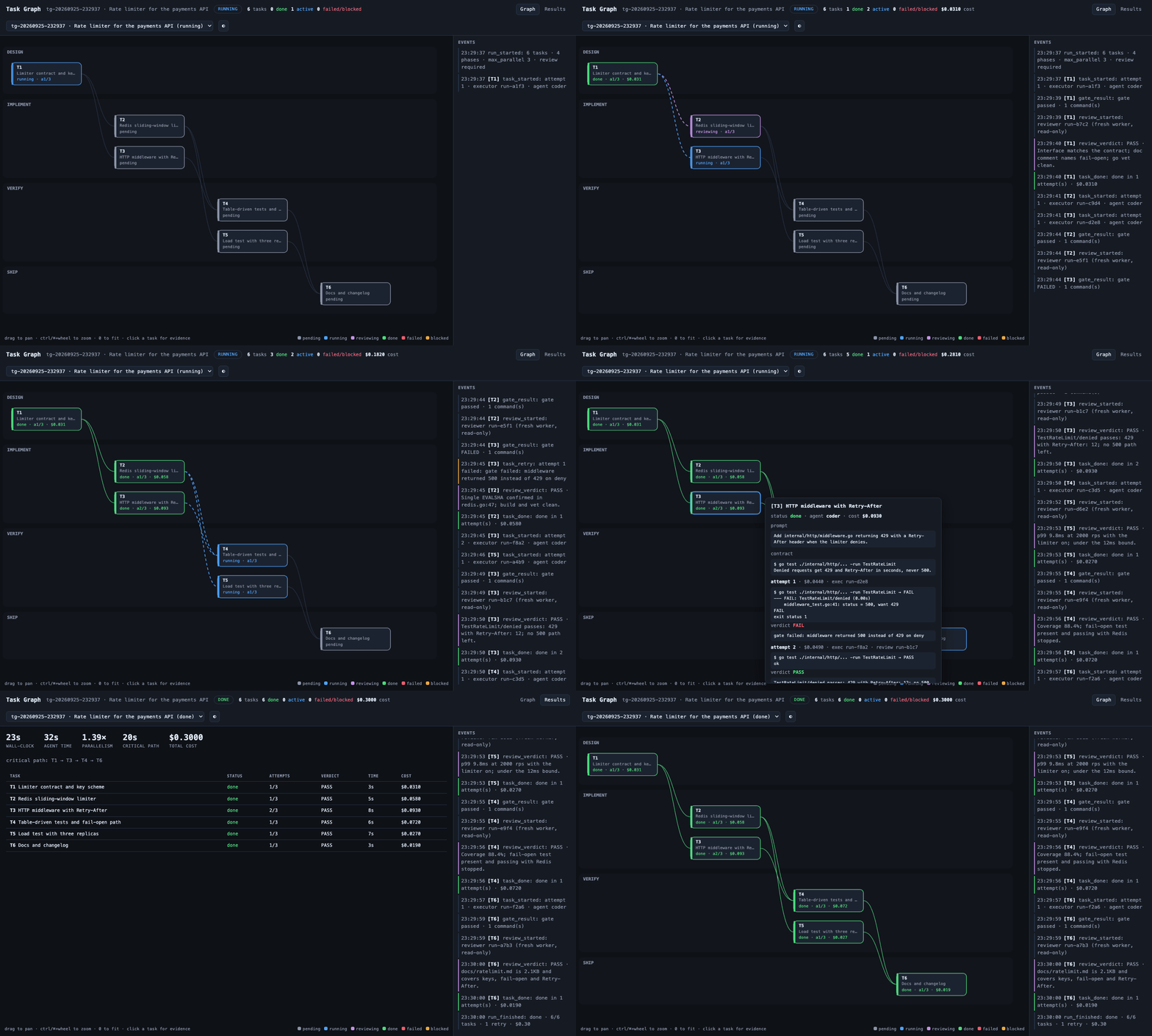
## The live dashboard
This dashboard goes deep on **one task graph run**. To watch the whole runtime live (every agent, LLM request, tool, skill, MCP server, pattern and background job, across processes), use [`/dash`](/usage/live-dashboard); task graph runs show up there too.
`/taskgraph dash` (or `{"cmd":"dash"}`) serves a browser dashboard from an ephemeral `127.0.0.1` port — a single embedded file, zero CDN, zero configuration:
* **Animated DAG canvas** — phase swimlanes, dependency béziers with animated dashes into running tasks, status-colored cards with attempt count and per-task cost; drag to pan, ctrl/⌘+wheel to zoom, `0` to fit, lineage highlight on hover.
* **Evidence popovers** — click a task for its prompt, validation contract, gate outputs, reviewer verdict + evidence and the executor/reviewer run IDs.
* **Results tab** — critical path, wall-clock vs agent time, parallelism factor and the real cost per task.
* **Live** — the page polls the persisted state every second and tails the event feed.
 The server is **strictly read-only**: it reads `state.json` and `events.ndjson` from disk on every request. Closing the dashboard never affects a run, and finished runs render just as well.
***
## Worker capabilities
Each executor and reviewer runs with the session's own context — proactive memory/session recall, CCR expansion of truncated results, and read-only memory/session/knowledge tools — so a worker picks up what the session already learned instead of starting blind.
Beyond that, two capabilities are opt-in per task:
* **Tool grants.** `"tools": ["@browser", "@websearch"]` on a task gives its **executor** those session plugins (builtins or `mcp_*`), gated by the same security policy — a `@browser click` prompts exactly as it would in `/coder`. The reviewer never gets tools (its job is inspection). `@browser` drives one shared page, so grant it to a **single** task at a time; parallel browser tasks would corrupt each other's element refs.
* **User skills.** A worker's task text is matched against your own [skills](/tools/builtin-skills) the same way the orchestrator matches them: pinned skills always apply, trigger-matched ones are injected (capped and budgeted). Your curated knowledge reaches every executor.
When a run finishes, a compact **learning digest** feeds the session's long-term memory (facts, episodes, self-evolving skill candidates) and a Reflexion lesson is queued for each failed task — so the graph teaches the session, not just delivers.
***
## Persistence
Each run owns `~/.chatcli/taskgraph//`:
| File | Role |
| - | - |
| `state.json` | The full graph, written atomically on every transition (corrupt files are quarantined, never overwritten) |
| `events.ndjson` | Append-only audit trail — also the dashboard's feed |
The store is **bounded**: runs older than 30 days are pruned automatically on the session's first store access (age = last state write), and `prune` cleans up on demand — Go durations (`72h`), day suffixes (`30d`) or `all`. The active run is never removed.
Runs appear in `/agents` (and the [Conversation Hub](/gateway/conversation-hub)) as a parent run with each executor and reviewer registered as children — cancellation propagates down the tree.
The task graph was inspired by the executor ≠ reviewer discipline of graph-style orchestration skills: self-declaration is not a verdict. In ChatCLI the orchestrator is native deterministic code, so the graph, the gates and the promotion to done are structurally out of reach of model hallucination.
This documentation is built and hosted on [Mintlify](https://mintlify.com), a developer documentation platform.
The server is **strictly read-only**: it reads `state.json` and `events.ndjson` from disk on every request. Closing the dashboard never affects a run, and finished runs render just as well.
***
## Worker capabilities
Each executor and reviewer runs with the session's own context — proactive memory/session recall, CCR expansion of truncated results, and read-only memory/session/knowledge tools — so a worker picks up what the session already learned instead of starting blind.
Beyond that, two capabilities are opt-in per task:
* **Tool grants.** `"tools": ["@browser", "@websearch"]` on a task gives its **executor** those session plugins (builtins or `mcp_*`), gated by the same security policy — a `@browser click` prompts exactly as it would in `/coder`. The reviewer never gets tools (its job is inspection). `@browser` drives one shared page, so grant it to a **single** task at a time; parallel browser tasks would corrupt each other's element refs.
* **User skills.** A worker's task text is matched against your own [skills](/tools/builtin-skills) the same way the orchestrator matches them: pinned skills always apply, trigger-matched ones are injected (capped and budgeted). Your curated knowledge reaches every executor.
When a run finishes, a compact **learning digest** feeds the session's long-term memory (facts, episodes, self-evolving skill candidates) and a Reflexion lesson is queued for each failed task — so the graph teaches the session, not just delivers.
***
## Persistence
Each run owns `~/.chatcli/taskgraph//`:
| File | Role |
| - | - |
| `state.json` | The full graph, written atomically on every transition (corrupt files are quarantined, never overwritten) |
| `events.ndjson` | Append-only audit trail — also the dashboard's feed |
The store is **bounded**: runs older than 30 days are pruned automatically on the session's first store access (age = last state write), and `prune` cleans up on demand — Go durations (`72h`), day suffixes (`30d`) or `all`. The active run is never removed.
Runs appear in `/agents` (and the [Conversation Hub](/gateway/conversation-hub)) as a parent run with each executor and reviewer registered as children — cancellation propagates down the tree.
The task graph was inspired by the executor ≠ reviewer discipline of graph-style orchestration skills: self-declaration is not a verdict. In ChatCLI the orchestrator is native deterministic code, so the graph, the gates and the promotion to done are structurally out of reach of model hallucination.
This documentation is built and hosted on [Mintlify](https://mintlify.com), a developer documentation platform.